Showing posts with label math activities. Show all posts

Sunday, July 15, 2018

Headbands Are All the 'Math' Rage!

Where do I start with this little piece of genius I was taught a few summers back?!?!  There are no words for the educational value of these 6 strips of paper.  


Way back in the summer of 2016, my life was forever changed when I joined a grant through Texas Regional Collaboratives.  UTMB in Galveston had a Grant taught by Valerie Blackburn and Jennifer Clayton.  

So of course, I needed to create one for my class.  This little gem was shared and it has snowballed on our campus!  Yes, almost all levels of core math use it now. 
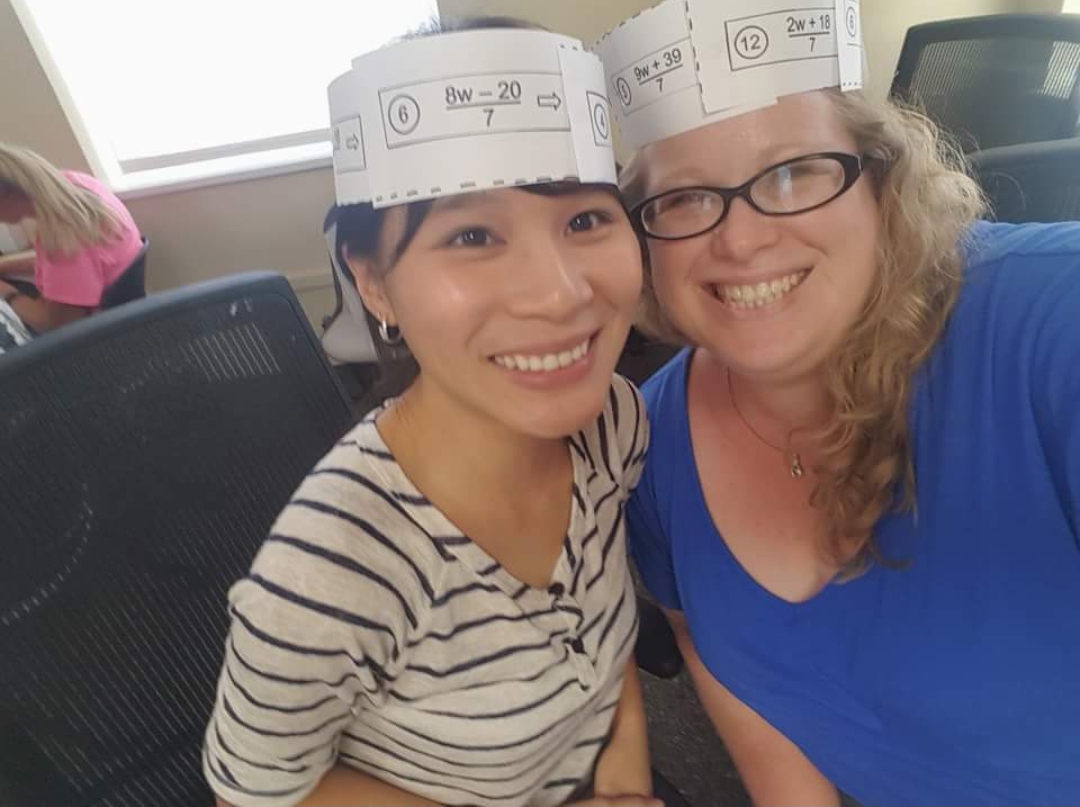


The first one was a little more intense than I realized and lasted way longer than I planned BUT the results were well worth it!  We spent 30 minutes in my Algebra 1 class doing the slope from tables one.  I was able to get a lot of formative assessment and in the end ALL students completed and worked diligently on 6 critical problems. 


This resulted in one of my favorite teaching moments of all time... 

Student: 'What's the point of this?'
Me: **thinking quickly of a witty response** 'When you put it on your head, you are learning by osmosis."  **secretly hoping they buy this**
Students:  'Oh my gosh, we are learning about that now in biology!! Cool!!'
Me: **thinking score cross-curricular vocabulary.**

I sent it to my principal laughing at the cross-curricular tie and it ended up going all though the district.  I even had teachers telling me students were wearing it in the cafeteria.  Later that year one student pulled it out and put it on during a test and when I asked him why, he said it made him feel smarter.  #teachermoment

Now let me share how to create your very first headband!  Any 6 problems will work and it is basically like a scavenger/mouse hunt.  You place the answer to a different problem on the left of the headband and a problem in the middle.  They solve the problem and connect/match it to the answer on a different piece forming a complete headband!


What I made a mistake of and was a reason the first time took so long was that you want to make all pieces connected like above.  The first time I had each piece with a space between and those precision cutters took forever!

AND DO NOT make them in order either... or then you have to redo and mix them all up... I've already been there, done that!

Each student recieves one copy of the headband to cut and construct.  I have a cut one projected on the board to show expectations. Sometimes I'll work one but most of the time I just demonstrate my expectations about connecting.  They solve the problem and look for the answer on another piece them solve that problem until they are back to the first piece.  Instant assessment for them which are my favorite kind of activities. 


I also have all mine designed to fit on 1 page.  Just as an FYI... these are great for those dark colored papers you might have that you can't really use for a WS.

AND don't worry, I've got templates for you as well as ALL my headbands shared below!

Another tip is to have students tape or staple them together so they can put them on right away.  And they will likely need to overlap and measure as they go.  I make them show work on the bands and just cover the answer or arrow.  One kiddo ended up making a belt instead so they can be pretty big. 

Here is what a couple of completed ones look like...


To store them, I just added a headband envelope in our notebook.


I'm not really sure how to say that I love these things!  I love seeing seniors wear them and post on their social media.  I even offer some credit for wearing them outside my class.  Anything to have kids talk about math!  

Some get creative with their'Headbands' too...


Get all resources here for FREE!!!  


I have them both in Word and PDF as always!  If you want my font, Janda Curly Girl, it is downloadable for free here!  It's one of my favorites!!

For any keys, please feel free to email me at camfan54@att.net from your school or professional account.  I've had students try and email for keys in the past but luckily their email said student! 

Enjoy the rage!!
Lisa

Friday, June 1, 2018

High Schoolers Just Wanna Have Fun Too!!

I have been teaching a variety of levels and classes over my 17 years as an educator!  As a matter of fact, 17 years comes to close today as I write this blog.  I am not in any way your typical teacher and in fact pride myself on being #thatteacher.  

So I end up with fabulous decorations like this for my room....


Some of what makes me #thatteacher is my desire to not only have fun myself but find new ways to engage my students.  It seems education instruction is a little more boring when you get to high school.  And the material often lends itself to a more traditional setting but I've found high schoolers enjoy the gimmicky and fun activities just as much as when they were in elementary.  Why shouldn't they be allowed a little cartoony creativity like we used as a teaching tool when they were younger?

Several weeks ago I was contacted by a representative of education.com after coming across my blog.  This is my style of teaching.  These are the perfect kind of activities to help me engage and motivate my students.  Some are short, some are corny looking but the basics and fundamentals of learning come in all packages.  

Who wouldn't rather graph on a fun map than plain old graph paper?!?!


Something I have really stressed in recent years to my students is 'you guys have been doing this forever!'  It just didn't necessarily look like this, especially with graphing.  You still feel like it might be too young looking or do not like the grade level, adapt to fit your needs.  Please never let the listed 'grade level' be indicative of the concepts.  We graph as Grad Students!

The lesson I was referenced was the Science Project: Parallax*.  I also learned what the parallax is and got a quick cross-curricular lesson for my high school math class when we do dilation!


Automatically I was drawn to the simplicity and design.  Visually intrigued, it has a natural 'hook' for curiosity.  And the best thing about it, it is completely FREE!  That's right, education.com has all these activities for FREE.  Just sign up for a FREE account and get ready to learn as well as teach.  There is nothing better to me as a teacher as saving time and ten fold when it helps save another teacher time and a hundred fold when it is FREE.

This project was created for education.com by Judee Shipman who has published a great deal of lessons for the site.  The basic premise of the lesson is as follows:

The parallax is a mathematical construct that is used to measure the distances of faraway objects like the moon and stars. It is defined as the difference between the apparent locations of an object viewed from two different perspectives. For instance, if you view a TV set from five feet to the right of it, and someone else views the same TV set from five feet to the left of it, the parallax would be the angle of perception from directly in front of the TV set. In this project you will make your own calculations using parallax principles.

Problem:

What is the parallax principle?

Materials:

  • Computer with Internet access
  • Color printer
  • Digital camera
  • Typical office/hobby/hardware/craft supplies (paper, poster board, glue, etc.).

Procedure

  1. Read overview of relevant topics (see bibliography below).
  2. Address all of the terms and research questions mentioned here.
  3. Search and print out compelling images relevant to your topic.
  4. Construct and solve your own parallax problems.
  5. Carefully record all measurements and results.
  6. Analyze your data.
  7. Write a detailed report.
  8. Include graphics, charts and diagrams in your science fair display.

It is set up for a science fair project but as all teachers know, you can get ideas and activities anywhere.  Just like our students, we can find inspiration in a number of places and activities.  If you are a math teacher and wondering why I'm referencing a science fair project, please see the above statement 😉💓.  I find ideas everywhere!  I love doing anything to engage my students.  And high school math often needs help in motivating and engaging, that is why I love finding new and wonderful sites like education.com.  I can not wait to use more from them next year!!

How fun for a basic and necessary concept!

You never know where new ideas will come from, be open minded and remember that high schoolers enjoy the fun they had as younger students.  And sometimes, we as teachers do too! 

Thank you!

Enjoy!
Lisa


*Disclaimer and Safety Precautions

Education.com provides the Science Fair Project Ideas for informational purposes only. Education.com does not make any guarantee or representation regarding the Science Fair Project Ideas and is not responsible or liable for any loss or damage, directly or indirectly, caused by your use of such information. By accessing the Science Fair Project Ideas, you waive and renounce any claims against Education.com that arise thereof. In addition, your access to Education.com's website and Science Fair Project Ideas is covered by Education.com's Privacy Policy and site Terms of Use, which include limitations on Education.com's liability.

Warning is hereby given that not all Project Ideas are appropriate for all individuals or in all circumstances. Implementation of any Science Project Idea should be undertaken only in appropriate settings and with appropriate parental or other supervision. Reading and following the safety precautions of all materials used in a project is the sole responsibility of each individual. For further information, consult your state's handbook of Science Safety.